Reforming training to improve the quality of military medical personnel

On November 13, in Hanoi, Vietnam Military Medical University (VMMU) held a ceremony to mark the 60th founding anniversary of the Pharmaceutical Training Institute (November 15, 1966–November 15, 2026). Major General, Associate Professor, Dr. Tran Ngoc Tuan, Deputy Director of the VMMU, attended and addressed the ceremony.
Delivering the commemorative address, Colonel, Associate Professor, Dr. Trinh Nam Trung, Deputy Secretary of the Party Committee and Director of the Pharmaceutical Training Institute, said that the Pharmacy Division under the Military Medical College (now the Vietnam Military Medical University) was established on November 15, 1966, laying the foundation for today’s Pharmaceutical Training Institute. During the resistance wars, officers, lecturers and cadets combined teaching and learning with research and the production of medicines to treat wounded and sick soldiers.
Research projects such as the development of the B76 burn treatment from Choerospondias axillaris bark and the production of berberine from Coscinium fenestratum demonstrated a spirit of innovation, professional expertise and the close link between scientific research and practical needs.
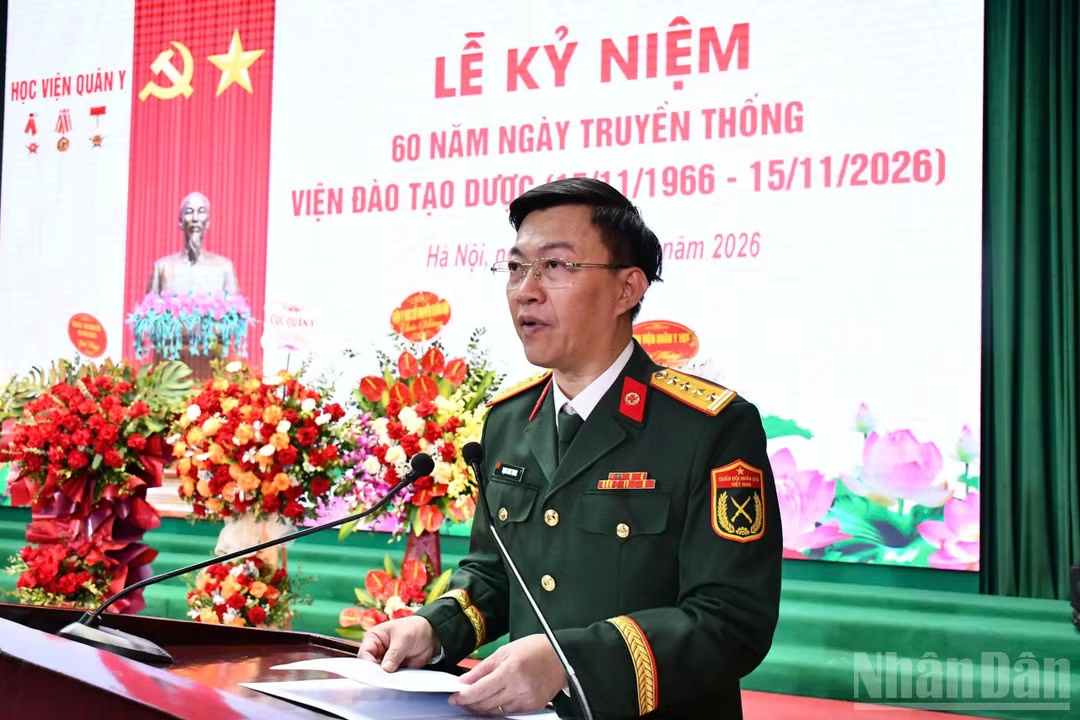
Colonel, Associate Professor, Dr. Trinh Nam Trung, Deputy Secretary of the Party Committee and Director of the Pharmaceutical Training Institute, delivers the commemorative address. (Photo: TUAN DUNG)
Through successive organizational restructurings, the Pharmaceutical Training Institute has steadily expanded its training programs, staff and research capacity. To date, it has trained more than 1,200 university-qualified pharmacists, 334 master’s degree holders and 58 PhD graduates. Many graduates have gone on to hold key positions in the military medical system and the healthcare sector.
Its scientific research focuses on drug development, medicinal plant resources, pharmaceutical formulation technology, pharmacology and toxicology. Many studies have been published in domestic and international scientific journals, with their findings gradually being put into practice. Officers and lecturers of the Pharmaceutical Training Institute have also taken part in COVID-19 prevention and control and trained military medical personnel for the Level-2 Field Hospital participating in United Nations peacekeeping operations.
Colonel, Associate Professor, Dr. Trinh Nam Trung affirmed that, at every stage of its development, the Pharmaceutical Training Institute has regarded as its central task the training of pharmaceutical personnel with strong political integrity, professional competence and a high sense of responsibility, capable of meeting the requirements of military medical support and public healthcare.
Speaking at the ceremony, Major General, Associate Professor, Dr. Tran Ngoc Tuan, Deputy Director of VMMU, congratulated and commended the Pharmaceutical Training Institute on its achievements over the years. He stressed that, amid the growing demands of military and national defence tasks and rapid advances in science and technology, the Institute must make training reform a breakthrough priority to improve the quality of military pharmaceutical personnel.
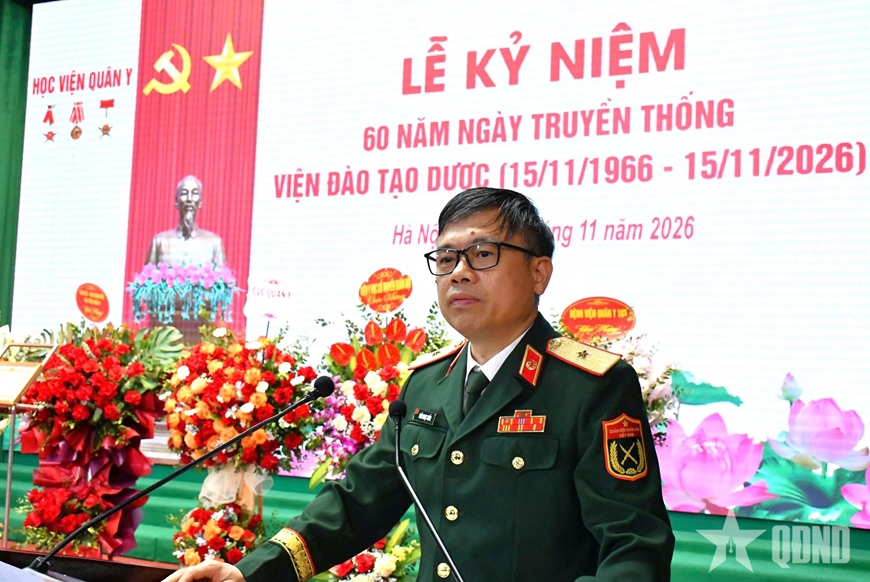
Major General, Associate Professor, Dr. Tran Ngoc Tuan, Deputy Director of the Vietnam Military Medical University, addresses the ceremony. (Photo: TUAN DUNG)
He called for the Institute’s curricula, course content and teaching methods to be regularly updated and modernized, linking foundational knowledge with professional practice and the specific requirements of pharmaceutical work in the military. In particular, greater emphasis must be placed on practical skills, the ability to apply knowledge and the capacity to handle professional situations, ensuring that graduates can quickly adapt to their working environment and successfully fulfil their assigned duties.
“Training must not only equip learners with professional knowledge and skills, but also cultivate political steadfastness, medical ethics, a sense of responsibility and organizational discipline. These qualities define military pharmaceutical officers who are professionally competent and ready to undertake and fulfil their duties under all conditions,” the University’s Deputy Director stressed.

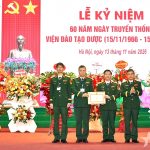
Major General, Associate Professor, Dr. Tran Ngoc Tuan, Deputy Director of the Vietnam Military Medical University, presents the University leadership’s Certificate of Merit to the Pharmaceutical Training Institute. (Photo: TUAN DUNG)
Alongside training reform, the University’s Deputy Director asked the Pharmaceutical Training Institute to identify focused research priorities that address practical issues in military pharmacy, using applicability and effectiveness in supporting mission requirements as the benchmarks of quality.
The unit must focus on developing its scientific staff, nurturing young officers, strengthening professional cooperation and advancing digital transformation. It must also build a clean and strong Party organization, foster solidarity and responsibility in setting an example, and create a military educational environment marked by order, discipline, humanity and creativity. These directions must be translated into concrete plans, clearly assigned responsibilities and substantive results.
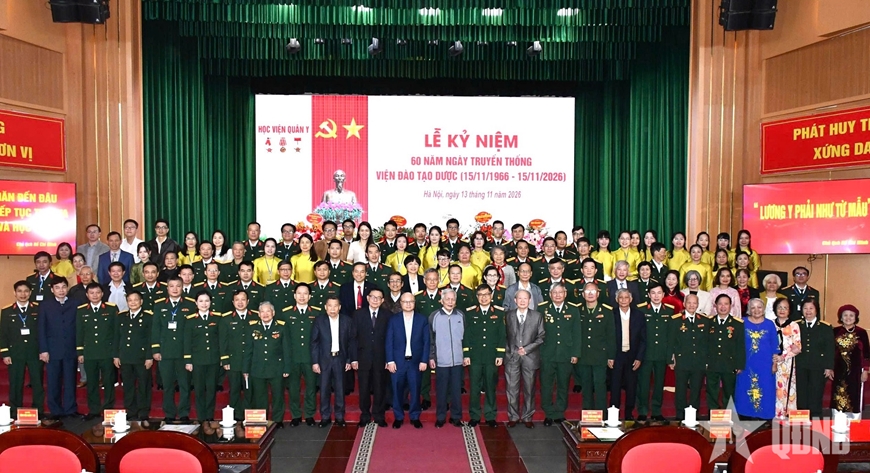
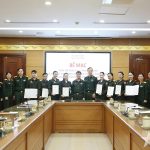
Delegates pose for a group photo at the anniversary ceremony. (Photo: TUAN DUNG)
On this occasion, Major General, Associate Professor, Dr. Tran Ngoc Tuan presented the University leadership’s Certificate of Merit to the Pharmaceutical Training Institute for its outstanding achievements in education, training and scientific research in military medicine and pharmacy during the 2020–2025 period.
As it enters a new stage of development, reforming training, linking scientific research with practice and strengthening the capacity to apply research findings will be key directions for the Pharmaceutical Training Institute to realize its potential and improve the quality of military pharmaceutical personnel. These efforts will help build a strong military medical sector capable of meeting the healthcare and health protection needs of troops and the public.
Do Thoa
TRANSLATOR: NGUYEN NGOC ANH