A New Advance in Male Infertility Treatment

After mastering the microTESE technique, the Military Institute of Clinical Embryology and Histology (Vietnam Military Medical University) is preparing to introduce the ROSI (round spermatid injection) technique from Japan. If successfully implemented, this will mark a new milestone in male infertility treatment, opening up further opportunities for cases that previously had almost no treatment options left to have biological children.
Opening a New Path for Male Infertility Treatment
Speaking with reporters, Colonel, Assoc. Prof. Dr. Trinh The Son, Director of the Military Institute of Clinical Embryology and Histology, stated that before 1992, men with azoospermia were considered almost incapable of fathering children. However, later studies revealed that about 40% of azoospermia cases are obstructive (meaning the testicles still produce sperm, but the sperm cannot travel out due to a blocked duct). Today, nearly 100% of obstructive azoospermia cases can yield sperm for assisted reproduction.
The remaining 60% of cases are non-obstructive azoospermia. To treat this group of patients, the most advanced technique available today is microTESE. Put simply, doctors go directly into the “production factory” to locate seminiferous tubules that are still capable of producing sperm for assisted reproductive procedures. This is a highly difficult technique because the patients all suffer from severe azoospermia. The surgeon must use high-magnification microsurgical microscopes and operate with meticulous precision to find active seminiferous tubules
As one of the first units to systematically implement the microTESE technique in Vietnam, the Military Institute of Clinical Embryology and Histology has mastered it and transferred the technology to numerous assisted reproduction facilities across the country. As a result, many babies have been born to couples who were previously thought to have no chance of having children. However, even with microTESE, there remain non-obstructive azoospermia patients in whom doctors cannot find mature sperm. For these cases, only very early-stage spermatogenic cells—known as round spermatids—remain in the testicles. This forms the basis for developing the ROSI technique.

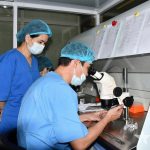
Doctors at the Military Institute of Clinical Embryology and Histology (Vietnam Military Medical University) check embryo fertilization. Photo: TUAN DUNG
Colonel, Assoc. Prof. Dr. Trinh The Son shared that while the ROSI technique has been researched for quite some time, implementing it remains challenging. Professor André Van Steirteghem (Belgium) was the first to propose the ROSI method. Later, Professor Atsushi Tanaka (Japan) further developed and applied the technique in clinical practice. According to publications by Professor Tanaka, over 100 babies have been born in Japan using the ROSI method to date. Many doctors from other countries have also traveled to Japan to learn the technique and deploy it in their home countries. Worldwide, approximately 1,000 babies have been born thanks to ROSI. However, the rates of embryo formation and overall success remain low.
Training Human Resources to Master the Technique
Colonel, Assoc. Prof. Dr. Trinh The Son noted that Professor Tanaka reported his research team has developed a new method involving DNA unwinding to enhance the efficacy of ROSI. The research findings are expected to be published in the near future and are anticipated to significantly improve the success rate of the technique. In light of these advances, the Military Institute of Clinical Embryology and Histology plans to send two doctors to Japan for direct training in ROSI. The unit hopes that upon completing their training in Japan, along with direct support from Professor Atsushi Tanaka in Vietnam, they will soon master the ROSI technique.
As one of the two institute doctors selected for training in Japan, Captain Dr. Pham Duc Minh shared: “I am very happy to be trusted and assigned this task by the Board of Directors. We will make every effort to study, fully grasp the protocol, and master the technique. During my time working at the Institute, I have always felt deeply concerned by the desire of many infertile men to become fathers. If successfully implemented, this technique will offer hope to patients who previously had virtually no treatment options left.”
Although ROSI remains a technique with a modest success rate that requires further refinement, the Military Institute of Clinical Embryology and Histology’s proactive approach to acquiring the technology and training workforce marks a new step forward in Vietnam’s assisted reproduction field. If successful, ROSI will offer the most severe cases of male azoospermia another chance to achieve their dream of having biological children, while contributing to enhancing the professional capability of Vietnamese medicine in assisted reproduction.
NEWS, PHOTO: THU HUONG
TRANSLATOR: TRAN MINH TUAN