Affirming Prestige in Orthopedic Trauma Treatment and Training

On August 11, 1960, the Department of Orthopedic Trauma (OT), the predecessor of the current Department–Center for Orthopedic Trauma of Military Hospital 103 under the Vietnam Military Medical University, was established. Over the past 65 years, generations of officers, physicians, and staff of the Department–Center have remained united, creative, and dedicated, overcoming all difficulties to build the proud tradition of a unit honored with the title Hero of the People’s Armed Forces, continuously affirming its prestige in orthopedic trauma treatment and training.
In a conversation with us, Colonel, Associate Professor, Dr. Dang Hoang Anh, Head of the Department of Orthopedic Trauma, proudly shared: “During the arduous years of the resistance war against the United States for national salvation, with courage and a readiness to sacrifice for the mission, dozens of officers and staff of the Orthopedic Trauma Department were present across fierce battlefields, providing medical care to tens of thousands of wounded and sick soldiers. As early as 1960, the Department was involved in training classes for young physicians, many of whom later became the core force in building the Army’s orthopedic trauma specialty. The heroic qualities of earlier generations created remarkable achievements and laid a solid foundation for the Department–Center to be awarded the title Hero of the People’s Armed Forces along with many other prestigious honors.”

Doctors and surgeons of the Joint Surgery Department, Department–Center for Orthopedic Trauma, Military Hospital 103 perform surgery on a patient. Photo: Le Cuong
Worthy successors to the tradition of their predecessors, today the team of physicians and nurses of the Department–Center for Orthopedic Trauma continues to make relentless efforts—promoting scientific research, developing new techniques, and applying modern medical advances in diagnosis and treatment. These endeavors have significantly improved the quality of medical care for both military personnel and civilians, establishing the unit as a prestigious center for orthopedic trauma treatment and training.
At the Department–Center for Orthopedic Trauma of Military Hospital 103, we heard many stories reflecting the dedication and sense of responsibility of military medical doctors. Recently, the Joint Surgery Department successfully operated on patient V.T.M., 103 years old, who suffered an unstable intertrochanteric femoral fracture and had multiple complex internal medical conditions. After consulting with specialists in cardiology, pulmonology, and neuropsychiatry and employing a multidisciplinary approach, the medical team chose long-stem hemiarthroplasty. This enabled rapid recovery, allowing the patient to sit up and begin walking exercises just three days after surgery.
According to Lieutenant Colonel, Dr. Pham Ngoc Thang, Deputy Head of the Department and Deputy Director of the Center, treating fractures in elderly patients presents major challenges due to osteoporosis and comorbidities. The technique applied is internationally advanced and is being adopted by several specialized orthopedic trauma hospitals in Vietnam, demonstrating high effectiveness in functional rehabilitation and improving patients’ quality of life.
In another case, the Department of General Trauma and Microsurgery recently received a 44-year-old male patient, T.V.V., who had a complete amputation of the lower one-third of his left arm due to a workplace accident. The medical team immediately performed emergency surgery to reattach the severed limb. After nearly five hours in the operating room, the patient’s arm was successfully replanted. Lieutenant Colonel, Dr. Vu Huu Trung, Deputy Head of the Department, noted that limb replantation requires surgeons with exceptionally high expertise and extensive experience in orthopedic trauma and microsurgery, along with mastery of advanced microsurgical techniques. Such procedures also require specialized modern equipment and close coordination among multiple units.
During our visit, patients and their families consistently described the physicians and nurses of the Department–Center as dedicated, enthusiastic, and attentive. We learned that the Department–Center consists of three units: the Department of General Trauma and Microsurgery, the Joint Surgery Department, and the Spine Orthopedic Trauma Department. Its functions include providing orthopedic trauma training for undergraduate and postgraduate learners; offering diagnosis and treatment for military personnel and civilians with trauma or musculoskeletal disorders; and conducting scientific research.
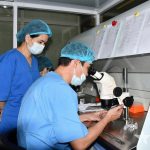
Lieutenant Colonel, Dr. Pham Ngoc Thang added that in recent years, the unit has continuously promoted scientific research, developed new techniques, and incorporated modern advances into practice. These include hip, knee, and shoulder joint replacements; arthroscopy of the knee, shoulder, ankle, elbow, and wrist; microsurgery; replantation of amputated fingers and hands; nerve transfer and grafting; and spinal reconstructive surgery. These advanced techniques are routinely applied at high volume, enabling the successful treatment of severe and complex cases, bringing “miracles” and improved quality of life to patients who suffered major injuries.
In recent years, the number of patients admitted and treated at the Department–Center has steadily increased. On average, the unit receives and treats more than 6,000 patient visits annually and performs between 3,500 and 4,000 surgeries, 70% of which are major operations.
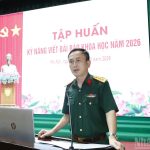
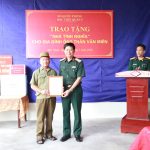
Alongside clinical work, the Department–Center has strengthened its efforts in training and scientific research. Over 65 years, it has trained nearly 120 medical doctors at the doctoral level, hundreds of master’s degree graduates, and many specialists at Levels I and II. It has organized long-term training programs for 57 cohorts of military doctors and 24 cohorts of civilian doctors, including training for medical personnel from Laos and Cambodia. The unit has participated in numerous high-quality state-level and ministerial-level research projects; many innovative techniques and solutions have been effectively applied in diagnosis and treatment. Medical staff have also been deployed to the Truong Sa (Spratly) Archipelago and to Level-2 Field Hospitals 2.2, 2.4, and 2.6 serving in United Nations peacekeeping missions in South Sudan. The Department–Center also regularly sends personnel to participate in medical outreach missions for wounded veterans and policy-beneficiary groups in remote areas.
Looking ahead, Colonel, Associate Professor, Dr. Dang Hoang Anh emphasized that the unit will focus on building a team of officers with firm political integrity, exemplary medical ethics, strong theoretical knowledge, proficient clinical skills, and high competence in foreign languages and information technology—to meet the requirements of a modern orthopedic trauma specialty. The nursing staff will continue to be trained in advanced professional expertise to better fulfill the healthcare needs of both military personnel and civilians. The goal is to develop the Department–Center into one of the country’s leading orthopedic trauma centers, gradually mastering advanced techniques aligned with regional and international standards.
In recognition of the dedication, sacrifice, and outstanding achievements of the Department–Center for Orthopedic Trauma over the past 65 years, the Party and the State have bestowed numerous prestigious awards, including the title Hero of the People’s Armed Forces; the First-, Second-, and Third-Class Feat-of-Arms Orders; and the Second- and Third-Class Fatherland Protection Orders, among others.
By Ha Thu, Translated by Phuong Linh