Body Donation – An Invaluable Gift Beyond Death

Within the natural cycle of human existence, death is often perceived as an end, where the physical body is buried and ultimately returns to dust. Yet for some individuals, although life has ceased, their bodies continue to “live” in another sense, leaving behind noble values and generating profound benefits for society.
The “Silent Teachers”
The specimen exhibition and preservation room of the Vietnam Military Medical University (VMMU) seemed imbued with a newfound warmth, enveloped in a solemn yet tender spirit of commemoration. The room was full of chrysanthemums, lilies, and roses arranged with reverence.
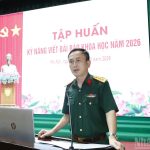
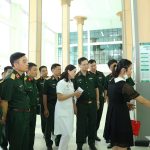
Amid the faint fragrance of incense, faculty members and students of the University entered solemnly, expressing deep gratitude and respect to those who had donated their bodies for the most altruistic of purposes. This annual commemoration is regarded as a shared death anniversary for individuals who have bequeathed their bodies to the University.
The shared sentiments among attendees were emotion, gratitude, and admiration. For generations of faculty and students at VMMU, those who donated their bodies to medical science are revered as “silent teachers,” contributing immeasurably to the education and training of highly competent physicians. According to Lieutenant General, Professor, Doctor Trần Viết Tiến, Director of the Vietnam Military Medical University, the memorial ceremony also serves as an educational forum on medical ethics and gratitude. It further inspires young and future physicians to strengthen their determination to expand their knowledge, refine their clinical skills, and uphold professional responsibility in safeguarding the health of soldiers and civilians alike.
Lieutenant General, Prof. Dr. Trần Viết Tiến noted that in recent years, despite remarkable advances in science and the availability of cutting-edge technologies that support medical training, hands-on practice on human cadavers remains indispensable, particularly in experimental and surgical training. For medical students, no instructional modality surpasses the human body itself.
In recent years, the Vietnam Military Medical University has received numerous donated bodies to support education and scientific research. The Universityhas also processed applications and issued hundreds of body donation registration cards to volunteers. In 2025 alone, the University provided counseling to over 1,000 individuals, received applications and issued donor cards to 75 volunteers, and accepted seven donated bodies for medical education and research. The quiet yet profound sacrifice of body donors has enabled VMMU to train thousands of physicians and healthcare professionals. It has also facilitated the development of hundreds of scientific research projects, many of which have been translated into clinical practice to improve diagnostic accuracy, therapeutic outcomes, and life-saving interventions.
Nguyễn Lê Tường Vy – cadet from Class DH58D, Branch 4, at the Vietnam Military Medical University, shared: “Medicine is an evidence-based science. Body donors are the most extraordinary teachers. Through their silence, they provide us with invaluable knowledge, helping us understand the intricacy of human creation through each anatomical structure, every muscle fiber, and every blood vessel. Each lesson learned from their bodies prepares us for future surgical procedures that will save the lives of our comrades and fellow citizens.”
It can be affirmed that learning from real human cadavers enables students to accurately comprehend anatomical structures, spatial relationships among organs, recognize anatomical variations, and develop clinical anatomical reasoning. This is an irreplaceable foundation in diagnosis and treatment. Cadaver-based education also plays a crucial role in cultivating practical skills, reducing the risk of medical errors, and facilitating advanced research and specialized training. Ultimately, it contributes to improving the quality of the healthcare workforce and enhancing the effectiveness of community health care.
In recent years, the Vietnam Military Medical University, particularly its Department of Anatomy, has promoted the implementation of the Thiel soft-embalming technique. This approach has significantly enhanced the quality of surgical training and the practice of modern medical procedures. Additionally, the University has intensified public communication through various channels, collaborating with relevant organizations to conduct outreach campaigns, and establishing a hotline and email system to provide information and counseling for individuals wishing to donate their bodies to medical science.
Encouragingly, the number of registered voluntary body donors continues to increase, reflecting a positive shift in public awareness and perceptions regarding body donation for medical education and research.

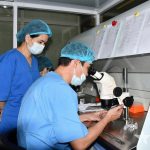
A lecturer from the Department of Practical and Experimental Surgery (Vietnam Military Medical University) instructs students in performing several basic surgical procedures. Photo by TUẤN DŨNG
“Though the Body Perishes, the Spirit Endures”
In Vietnamese culture, many people traditionally believe that after death, the body should be properly interred in a “peaceful and well-kept grave” to ensure spiritual repose. For those who voluntarily donate their bodies to medical science, this decision represents a noble act of self-sacrifice. Such an act transcends longstanding cultural beliefs and customs and makes a profound contribution to medical education and research.
Indeed, choosing to donate one’s body to science is never an easy decision. It entails an internal struggle, not only for the donor but also for family members and loved ones. However, when individuals come to understand that donating their body after death may offer others a chance at life, provide opportunities to unravel complex diseases, and strengthen the confidence and competence of future physicians, many ultimately choose to give. They stand as exemplary models of altruism and unconditional generosity.
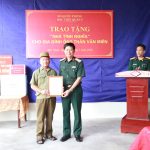
Ms. Nguyễn Thị Mai Hương, daughter of Mr. Nguyễn Đại Lượng, who donated his body to medical science at the Vietnam Military Medical University shared that her father’s decision was made after careful consideration, motivated by a desire to continue contributing to society after his passing. He openly discussed his wish with the family and received their full respect and support. Throughout the process of coordinating with the University to fulfill his final wish, the family received attentive guidance and dedicated assistance. This not only reflected the University’s professionalism in education and research but also provided the family with reassurance, trust, and even pride in knowing that their loved one, though deceased, continued to generate meaningful value for society.
“My father’s body has contributed to teaching and research activities. We firmly believe that his sacrifice and dedication will never be forgotten”, Ms. Hương said emotionally.
Similarly, Lieutenant Colonel (Non-commisioned Officer) Bùi Thị Nguyện, a teacher at Hoa Phượng Đỏ Kindergarten (Vietnam Military Medical University), registered to donate her body after death as a way of fulfilling her long-cherished aspiration to contribute to the medical profession, albeit in a different and more unique manner. She shared that as a child, she had dreamed of becoming a physician, using her hands and intellect to heal patients. Circumstances, however, prevented her from realizing that dream, which remained a source of regret. Consequently, she chose another meaningful path: to dedicate her body after death to support the teaching and scientific research activities of faculty and students at the Academy. For her, this is a profound way to fulfill a lifelong aspiration.
Sharing the same perspective, Ms. Nguyễn Thị Vân, currently residing in Hà Đông Ward, Hà Nội, considers the decision to donate her body for educational and scientific purposes to be one of the most important choices of her life. “We hope that our bodies, after death, will truly serve as living learning materials, enabling physicians, lecturers, residents, and medical students of the Vietnam Military Medical University to gain the most authentic and accurate understanding for study and research,” she stated.
Over the years, the quiet yet noble contributions of body donors have enabled the Vietnam Military Medical University to continue training generations of physicians who are not only highly competent and technically proficient but also deeply grounded in medical ethics and profoundly aware of the value of human life.
Though they have departed, body donors remain present in the knowledge they leave behind and in the progress of medical science like timeless blossoms that continue to offer their fragrance for the good of humankind.
Author: Ngoc Han, Translated by Minh Phuong