Innovation and Improvement in Training and Medical Services

During the 2020–2025 term, the Party Committee and the Board of Directors of the Vietnam Military Medical University (Ministry of National Defense) have strictly implemented the resolutions of the Party, the Central Military Commission, and the 22nd Party Congress of the University. A key highlight of this period is the innovation and enhancement of the quality of training and medical examination and treatment services.

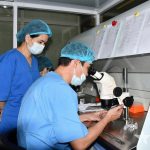
Lecturers from the Department of Practical and Experimental Surgery (Vietnam Military Medical University) instruct students.
Thoroughly grasping the resolutions of the Party and the Central Military Commission on comprehensively renewing education and training in the current context—as well as related projects, plans, and reform programs—the Party Committee and the Board of Directors of the Vietnam Military Medical University have provided strong leadership and effectively implemented the resolutions concerning education and training. Their focus has been on completing and deploying integrated undergraduate (General Medicine, Pharmacy) and postgraduate training programs based on competency and learning outcomes.
The University has launched four master’s degree programs and eight doctoral programs, as well as a training program for preventive medicine physicians. At the same time, it has reviewed, updated, and refined the content and curricula for internal medicine, field surgery, military medical exercises, and clinical internships at affiliated units.
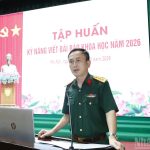
In addition, the university has updated the English language training program for military general practitioners; opened second-degree training programs, international certificate English classes, and VSTEP preparation courses. Training and student management have been enhanced through the increased application of information technology. Regulations and procedures related to education and administration have been reviewed, updated, and synchronized. The university has also effectively operated its centers, laboratories, and experimental facilities, while compiling and supplementing textbooks, teaching materials, and resources to improve training quality.
Vietnam Military Medical University has also achieved strong results in scientific research, with a wide range of research directions carried out by various departments, units, and research groups. Notably, many state-level and ministry-level research projects have been successfully implemented and applied in practice.
The scientific research movement has been actively promoted, resulting in numerous high-ranking projects, innovations, and initiatives. Several have received exclusive patents, utility solutions, and awards, and have significantly contributed to training, diagnosis, and treatment.
Of particular note is the increased publication of scientific research in reputable domestic and international journals indexed in the ISI/Scopus system, with a 21.4% increase compared to the set target.
In addition to achieving strong outcomes in training and scientific research, the university has also placed great emphasis on medical examination and treatment. This has included efforts to strengthen medical ethics education, raise a sense of responsibility, and improve the service attitude of healthcare staff.
The university has organized professional training and exchange workshops, and sent officers, doctors, and nurses to attend advanced technical training courses both domestically and internationally to enhance their professional capacity. At the same time, it has proactively reviewed and completed the development of procedures related to laboratory testing, medical techniques, surgery, diagnosis, and treatment.
Many new, advanced, and modern techniques have been applied, contributing to improving the quality of training, implementing the military–civilian medical collaboration program, and supporting lower-level hospitals. The university has also promoted the integration of traditional medicine with modern medicine in consultation and healthcare services for military personnel and the public. As a result, key targets related to medical examination, emergency care, and treatment admissions have all exceeded the levels set by the Party Committee’s resolution.
During the COVID-19 pandemic, under the motto “fighting the pandemic like fighting the enemy,” the university’s medical staff, doctors, officers, and students worked alongside armed forces across the country. They bravely entered outbreak zones, accepting risks and hardships in order to serve, care for, and treat people in severely affected areas.
Aligning with national strategies and education development programs, during the 2025–2030 term, the Party Committee and the Board of Directors of the university will continue to lead efforts to innovate and enhance the quality of education and training, with the guiding principle: “The training quality of the university reflects the combat readiness of the unit.”
The university is working toward building a smart, modern institution, striving to meet the basic criteria of a research-oriented university by 2030—positioning itself among the leading national institutions in the health sciences.
The university continues to modernize its teaching and learning methods, with a focus on developing military medical and pharmaceutical training programs. Learner evaluation is now oriented toward developing personal qualities and competencies, encouraging innovation and creativity. Teaching and learning are carried out with substance and integrity, ensuring that student performance is assessed accurately and fairly. The university is also investing in infrastructure and facilities, upgrading and applying information technology, and advancing digital transformation to meet the demands of education reform.
VMMU is committed to fulfilling its core responsibilities in medical examination, emergency care, patient admission, and treatment—aiming toward comprehensive healthcare services. The university is working to build a smart hospital model and a modern university-affiliated hospital, with the goal of becoming an exemplary, advanced medical center serving the health needs of both military personnel and the general public.
At the same time, the university will strengthen scientific research, innovation, IT application, and digital transformation. Research will focus on military medical and pharmaceutical sciences, technology, and strategic products in healthcare and medicine.
The university strives to achieve between 7 to 12 national-level research projects, and 35 to 40 ministerial-level or equivalent projects. Each year, over 120 articles are expected to be published in international journals indexed by ISI/Scopus. In addition, 100% of textbooks and training materials will be digitized to support education and training—contributing to the development of a revolutionary, regular, elite, and modern Vietnam People’s Army, capable of fulfilling its national defense mission in the new era.
Lieutenant General, Prof. Dr. TRAN VIET TIEN, Deputy Secretary of the Party Committee, Director of the Vietnam Military Medical University
Translator: NGUYEN NGOC ANH