Parasitologists and Entomologists

The Department of Parasitology and Entomology at the Vietnam Military Medical University (VMMU) traces its roots back to the Parasitology Department under the Faculty of Epidemiology, Microbiology, and Parasitology at the Military Medical Officer School, which was officially established on June 2, 1966.
Over the past 60 years, generations of the department’s staff and faculty have maintained a steadfast presence across lecture halls, battlefields, and local communities. Balancing combat duties and the treatment of wounded soldiers with rigorous research, teaching, diagnostics, and clinical care, they have quietly yet significantly contributed to medical training, scientific advancement, and the healthcare of both the armed forces and the public.
Major General Professor Le Bach Quang, PhD, former Vice President of VMMU and former Head of the Department of Parasitology and Entomology, often recalls the rudimentary nature of those early days. The initial workforce consisted of just two doctors, seven staff members, and one soldier, led by Captain Dr. Nguyen Phuc He. From laboratories to instructional materials, everything had to be built from scratch. Despite these hurdles, the pioneering faculty actively compiled textbooks and developed training curricula tailored to the practical needs of military medicine and the pressing disease-prevention demands of the army at the time.
As the resistance war against the US reached its fiercest stage, these soldier-physicians marched to the front lines under orders. They simultaneously engaged in combat, treated casualties, and conducted vital research on malaria. Doctors such as Nguyen Phuc He, Vu Van Phong, Nguyen Kim Bang, and Bui Dung Ma braved the strategic Truong Son Range amid a hail of bombs and bullets to conduct field surveys, study disease patterns, and pioneer effective treatment and prevention strategies for troops in the Central Highlands, along the Truong Son trail, Southern Laos, and the Southeastern battlefield.
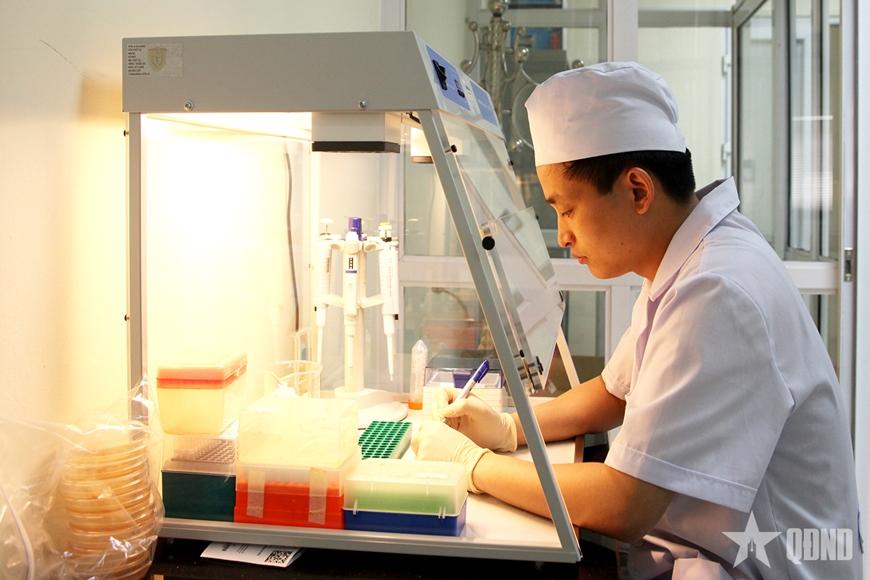 |
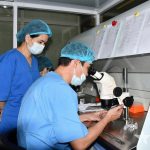
| Staff of VMMU’s Department of Parasitology and Entomology at work in the laboratory. Photo: TRANG QUYNH |
To this day, the legacy left behind by Colonel Associate Professor Vu Van Phong, PhD, former Head of the Department of Parasitology and Entomology, still includes wartime letters sent to his family from the front lines. Through the ink faded by time, I can deeply feel the harsh realities of war. In these letters, the professor recounted grueling days of climbing steep slopes while carrying heavy loads, battles with jungle malaria, and sleepless nights on the march—yet his words remained brimming with optimism.
For our generation today, behind those faded pages lies a fierce battlefield ravaged by malaria, bombs, and bullets. They serve not only as a memory of an era when our predecessors selflessly fought under a hail of bombs and bullets for national independence, but also as a sacred testament to the silent sacrifices of past generations, particularly the military medics on the front lines.
Parallel to their frontline duties, the department executed numerous scientific research projects of high practical value. Prominent among these were studies on DDT chemical residue levels in bunkers and trenches, alongside investigations into malaria and scrub typhus in Son La Province. This work yielded a breakthrough by identifying scrub typhus as the root cause of prolonged fevers among soldiers, leading to the development of an effective treatment protocol. Additionally, the department mapped out trichinosis outbreaks in Yen Bai Province and discovered scrub typhus foci in Do Son (Hai Phong) and Nghi Son (Thanh Hoa). These findings played a crucial role in disease prevention, safeguarding the health of both troops and civilians across the northern provinces during that era.
Following 1975, during the Southwestern and Northern border defense wars, the mission to research and combat malaria and parasitic diseases on the battlefield remained a critical priority. Faculty members, including Dr. Nguyen Kim Bang, Dr. Le Bach Quang, and Dr. Trinh Trong Phung, once again deployed to the front lines to spearhead malaria control efforts. During this period, the department also intensified its research on disease vectors and pioneered the use of herbal medicine to treat parasitic infections, at a time when the country faced a severe shortage of western pharmaceuticals.
In the early 1980s, when numerous military units stationed along borders and remote islands were plagued by mosquitoes, biting midges, and disease outbreaks, the department’s staff embarked on extraordinary experiments. Utilizing mần tưới (Eupatorium fortunei), a herb growing wild in nature, Doctors Vu Van Phong, Dinh Thi Dan, and Nguyen Quy Nhuong successfully researched its mosquito and midge-repelling properties to protect soldiers at remote border outposts and isolated islands. Amidst a dire scarcity of conventional medicines and chemicals, these innovations held immense practical value for the daily lives and health of the troops.
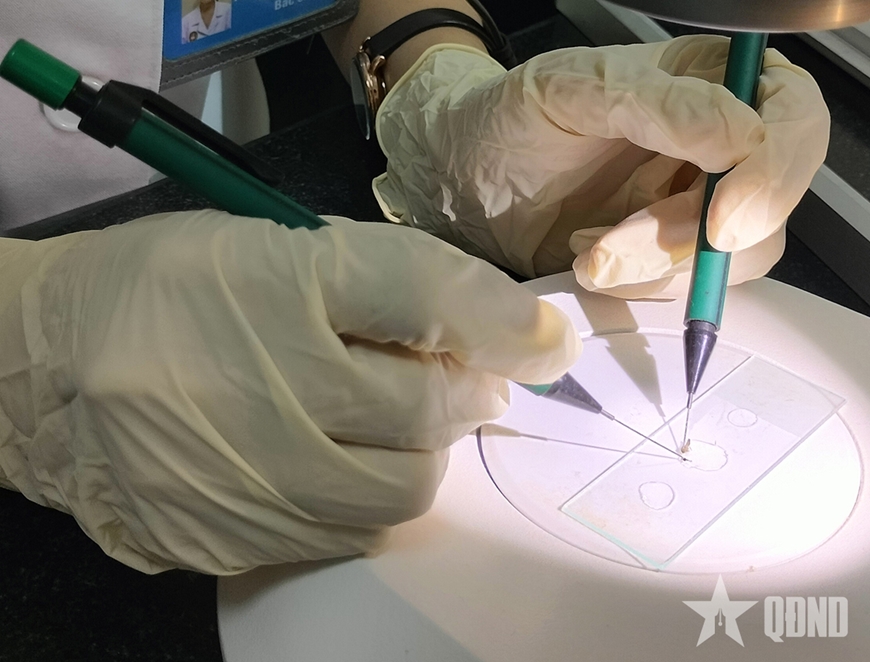 |
| Staff of VMMU’s Department of Parasitology and Entomology at work in the laboratory. Photo: TRANG QUYNH |
During the era of economic embargoes and severe national hardships, the country faced acute shortages of medicine while human parasitic infections remained rampant. In response, the department’s physicians proactively researched and applied herbal remedies to combat these diseases. Between 1983 and 1985, Associate Professor Vu Van Phong, PhD, investigated the efficacy of traditional herbs—such as chinaberry root bark, Rangoon creeper, and river tamarind—against human and porcine roundworms. This project held immense practical value at a time when conventional medical supplies were heavily restricted and anti-parasitic treatments were scarce.
The department also secured numerous other milestones in scientific research and epidemic control. Notably, it co-discovered and studied several new or rare pathogens in Vietnam, including Leishmania, Trypanosoma lewisi, and the “brain-eating amoeba.” Furthermore, they identified and assessed areas with vectors transmitting drug-resistant malaria. These findings not only carried profound scientific and clinical value for diagnosis and treatment but also cemented the department’s professional prestige and research capabilities in parasitology, microbiology, and tropical medicine.
Entering the 1990s, the department further solidified its standing as one of the premier parasitology training and research hubs for both the military and the nation. A series of strategic scientific projects focusing on vector control, the treatment of drug-resistant malaria, and arthropod research were successfully implemented.
Today, the department’s infrastructure and scientific potential have been robustly enhanced. State-of-the-art lecture halls and laboratories now drive its teaching and research missions. This includes two advanced molecular biology labs dedicated to diagnostics and pathogen identification, paving the way for high-level academic training and specialized scientific endeavors.
 |
| Staff of VMMU’s Department of Parasitology and Entomology at work in the laboratory. Photo: TRANG QUYNH |
Today, the stature of the Department of Parasitology and Entomology is measured not merely by its scientific breakthroughs, research volume, or international publications, but by the continuity of a unique military science tradition: conducting research to serve the battlefield, the soldier, and the public. Guided by the core philosophy, “The quality of institutional training dictates the combat readiness of the unit,” generations of the department’s faculty and staff have consistently bridged education and research with the operational realities of military units and the community. Their ultimate goal remains elevating healthcare capabilities to protect troops and civilians under all circumstances. This dedication has forged the distinct identity and enduring legacy of the department throughout its 60-year journey of growth and development.
Six decades represent a journey long enough to solidify mettle and tradition. Yet, for these military medical professionals dedicated to parasitology and entomology, the journey is far from over. Ahead lie new battlegrounds: emerging epidemics, zoonotic diseases, climate change impacts, natural disasters, dangerous infectious pathogens, and the escalating challenges of global health security.
In an era defined by the rapid rise of biotechnology and artificial intelligence, these “soldiers in white” at the Vietnam Military Medical University’s (VMMU) Department of Parasitology and Entomology quietly press forward on the path paved by their predecessors—a path of education, scientific inquiry, and patient care, driven by a profound sense of duty and deep compassion.
| Since 1995, the department has spearheaded and successfully completed numerous scientific research projects across multiple tiers, including two state-level and ten ministry- and provincial-level initiatives. Its academic footprint features over 30 prestigious international papers published in ISI/Scopus-indexed journals, alongside hundreds of articles in domestic publications. Many of these research outcomes have been implemented with great practical success, actively driving progress in the treatment and prevention of infectious diseases, most notably malaria.On the global stage, the department’s contributions have earned high praise from international peers and colleagues. Prominent highlights include its active participation in the Neglected Tropical Diseases Conference at Khon Kaen University (Thailand), as well as its collaborative academic training and research programs with Japan’s National Institute of Infectious Diseases (NIID). |
Do Ngoc Anh
TRANSLATOR: NGUYEN NGOC ANH