SELF-MADE “SPECIAL MEDICINE” IN THE MIDDLE OF THE BATTLEFIELD

During the years of the resistance war against the United States, for national salvation, ‘B3min’ was a type of tonic that our B3 Front soldiers considered a ‘miracle drug’ in the battlefield,” Major General Nguyen Tu, a People’s Armed Forces Hero and former Deputy Director of the Vietnam Military Medical University, recounted to us about one of the “self-made” pharmaceutical products of the B3 military medical soldiers when he was serving as the Head of the Medical Corps in the Central Highlands Front.
The story goes that around the years 1969-1970, whenever the rainy season began, along the banks of the Po Ko River (in Kon Tum province), there would be a significant emergence of earthworms. It was known that earthworms contain abundant nitrogenous compounds and can be used to treat malaria. Since many soldiers and war victims under the care of the B3 medical personnel suffered from malnutrition due to insufficient nutrition, they often experienced weakened health and severe cases of malaria. Therefore, the military medical personnel went to the riverbanks to gather a large number of earthworms.
Afterward, those quintals of earthworms were taken for hydrolysis to produce medicinal tablets to serve the weakened soldiers. “We called it ‘hydrolysis,’ but in reality, we boiled the earthworms and concentrated the solution. After eliminating the pungent smell, these ‘self-made’ nitrogen tablets became pleasantly fragrant. We named this type of ‘battlefield tonic’ B3min,” recalled Major General Nguyen Tu.
In addition to the “homegrown” tonic from earthworms, the Highland Front military medics also made a tonic that, now told, many would say is a bit … luxury, it’s elephant bone scraping.
“At that time, elephants were not rare and were not banned from hunting like they are now. To improve our meals, B3 soldiers often went into the forest to hunt elephants. When we successfully hunted an elephant, the meat alone would weigh several hundred kilograms. However, due to the difficult transportation routes, we couldn’t bring all of it back to the unit. So, we marked the location and waited for the next rainy season, when the putrid smell of the elephant meat would dissipate. The military medical personnel would then bring a steamer to cook the elephant bones right on the spot, turning them into powdered form. With these ‘mobile pharmaceutical workshops,’ we were able to produce 2 to 3 tons of elephant bone powder in some years to support the health of the wounded soldiers,” Major General Nguyen Tu recounted.
 |
|
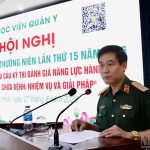
Major General Nguyen Tu |
Around the years 1966-1967, when the B3 Front medical team first set foot on the battlefield in the Central Highlands, they faced a series of difficulties and shortages, with the greatest challenge being the lack of medicine and medical supplies. Major General Nguyen Tu recounted that there were times when the medical officers from Institute 211 had to make use of the cotton bandages used by lightly wounded soldiers, wash them, dry them, and then reuse them. It was not uncommon to see nurses dipping pieces of cotton into boiling water to sterilize them before applying them to patients’ skin, as they lacked alcohol. The alcohol sent from the rear to the battlefield had evaporated almost completely after months of transportation. The pharmaceutical team of the Pharmacy Department at Institute 211 had to come up with a plan to produce a substitute for alcohol, which led them to consider producing a type of liquor.
However, to make liquor, one needs yeast and starch. How could they obtain yeast in the midst of the battlefield in the Central Highlands? The Pharmacy Department of Institute 211 sent their officers to have “three together” with ethnic minorities to learn how to make yeast from the process of brewing beer. After learning how to make yeast from forest leaves, they utilized the damp rice stored in warehouses to cultivate yeast. As for the distillation pot, it was improvised by a “forging unit” using metal salvaged from enemy aircraft wreckage. After a period of trial and error, the first batch of liquor was distilled right on the battlefield. Needless to say, the B3 medical personnel were overjoyed because once they had their own liquor supply, the pharmacists could easily produce various types of alcohol to meet the medical needs of the wounded and sick soldiers on the battlefield.
In addition to the homemade “medicines” for patient treatment, the white-clad soldiers of the B3 Front also created another morale-boosting product during the days of gunfire and bullets: the book “Highland Military Medical Journal”, along with other books that shared experiences in treating wounds and disseminated regulations for emergency internal medicine on the battlefield.
Major General Nguyen Tu stated that with hundreds of medical personnel deployed to the B3 battlefield, mainly consisting of highly skilled doctors and physicians from hospitals 103 and 108, he proposed the establishment of the Military Medical Council of the Central Highlands to General Hoang Minh Thao at the end of 1970. With the establishment of the Medical Council and the Military Medical Journal published regularly every quarter, colleagues had the opportunity to showcase their scientific research and exchange valuable information directly on the battlefield, serving their professional expertise.
“After the reunification of the country, I gathered all over 20 issues of the “Central Highlands Military Medical Journal” and donated them to the Military Medical Museum. However, when the Military Medical Museum merged with the General Logistics Department Museum, I went to retrieve those journals, but unfortunately, they had been lost,” Major General Nguyen Tu said with a regretful voice.
The Military Medical General who has been associated with the Central Highlands battlefield for many years hopes that his comrades will have someone to keep the original printed books of that day, because they are not only memorabilia of a time of fire but also authentic documents that help summarize the war.
News, photos: BUI VU MINH, Translator: Nguyen Thanh Nga