The 42kg female valedictorian of the Vietnam Military Medical University shares her story of carrying sandbags during military marches.

When she first entered the Vietnam Military Medical University, the female valedictorian weighed only 42kg, not enough to meet the health requirements for participating in the six-month basic training before starting her academic program.
Nguyen Thi Trang, born in 1999, is a student of General Medicine at the Vietnam Military Medical University. With an academic average of 8.5/10, Trang became the valedictorian of her graduating class and was promoted to the rank of Lieutenant. After graduation, she continued preparing for the residency exam and achieved the highest entrance score in Internal Medicine.
“These achievements were something I never thought I could attain when I first entered the school. But through effort and determination, anything became possible,” Trang shared.

Nguyen Thi Trang is the valedictorian of the Vietnam Military Medical University (Photo: NVCC).
Nguyen Thi Trang, a former student of the Biology-specialized class at Vinh Phuc High School for the Gifted (Vinh Phuc Province), decided to pursue a career in medicine immediately after winning second prize in the National Excellent Student Competition. Coming from a modest farming family with two younger siblings, Trang realized at the time, “If I went to study at Hanoi Medical University, my siblings might not have the opportunity for an education.”
As a result, she chose to apply directly to the Vietnam Military Medical University, where she wouldn’t have to pay tuition fees and would receive a monthly stipend, easing the financial burden on her parents. This decision was fully supported by her grandfather, who said, “He wanted me to attend a military school to build my character and help me mature,” Trang recalled.
However, upon entering the university, Trang weighed only 42kg, which did not meet the health requirements to participate in the six-month basic training in Son Tay. It took her nearly two weeks of staying back at the school before she was able to join the training with her peers.
During these six months, the new students had to undergo military and political training, primarily conducted on the training grounds. Trang and her classmates participated in long marches, learned how to fire weapons, and studied military tactics.
“There were times when we had to march 5-6km, carrying a sandbag in our backpacks. Even though it was exhausting, moments like sharing a single energy bar among 10 of us made me feel more mature and appreciate the camaraderie of my fellow students,” Trang fondly recalled.
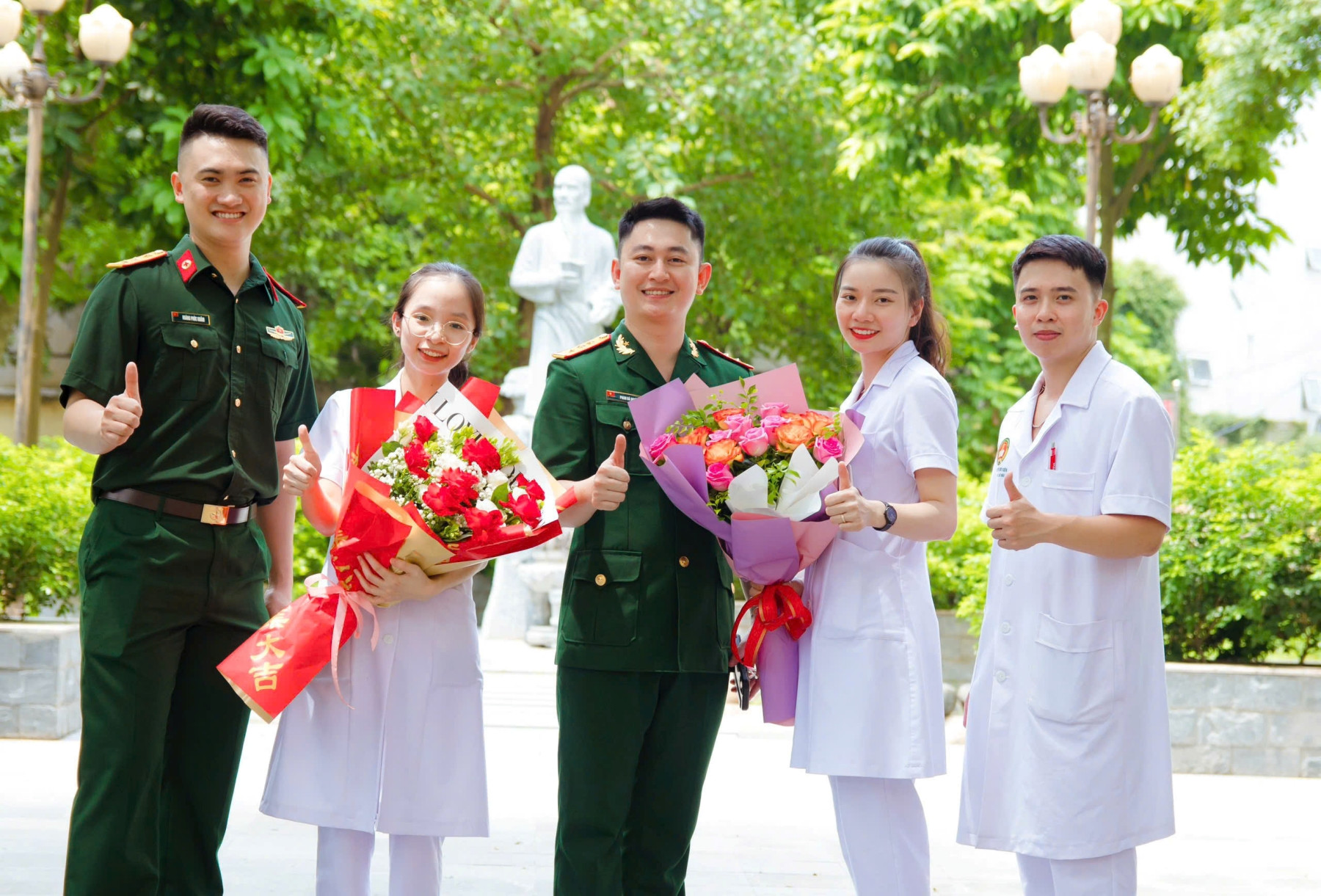
Trang (second from the left) and her classmates. (Photo: NVCC)
After completing six months of training and returning to the university, Trang continued studying both political subjects and specialized courses. The study schedule for students at the Military Medical University typically lasted from morning until evening. Even during meals or attending lectures, students had to line up. Outside of class, students participated in general cleaning, studied military regulations—a basic requirement in the military—and took turns standing guard.
In addition to physical training and national defense courses, according to Trang, the specialized curriculum was not too different from that of other medical schools. In the first year, students studied basic sciences such as Mathematics, Physics, Chemistry, and Biology. By the second year, they began core subjects like Anatomy, Physiology, Histology, and Biochemistry.
Having always been a top student in high school, receiving close guidance from teachers, Trang felt disoriented upon entering university because everything was far from what she had imagined.
“In the beginning, I didn’t know how to connect the subjects, so the knowledge felt overwhelming and confusing. The classes were too large, with 120 students, and the lecturers spoke very quickly. There were times when the lesson ended, and I still didn’t understand what I had just learned. During the first two years, I would often doze off in class and couldn’t take proper notes.”
Trang admitted that during that time, her studies were quite shaky, and she felt she was falling behind, even questioning her own choices. Fortunately, with the help of upperclassmen, Trang learned how to take notes, prepare materials ahead of time, and study in groups. Gradually, her grades began to improve.
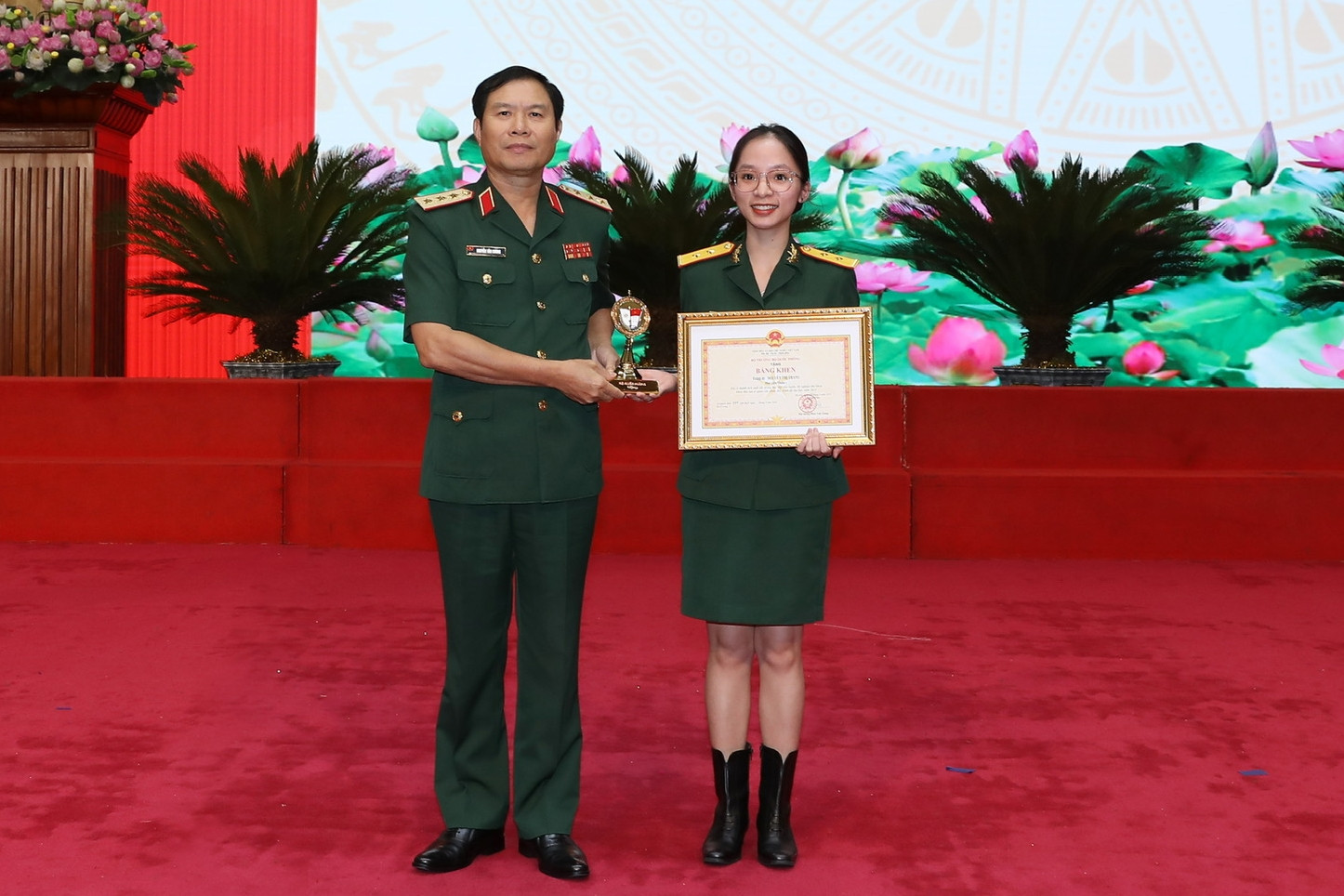
Trang receives a certificate of merit for her outstanding academic achievements (Photo: NVCC).
By her third year, when she began studying specialized subjects and interning at the hospital, Trang had learned how to study more effectively and started to enjoy her courses. Additionally, she improved her memory and note-taking skills, which allowed her to consistently win school scholarships.
These achievements motivated Trang to set a goal of passing the residency exam. “Once I had a clear goal, throughout my studies, I focused on gathering materials and taking detailed notes, so by the end of my sixth year, I would have a diverse set of study resources for review,” Trang explained.
In addition, students must meet certain criteria to be eligible to take the residency exam, including maintaining an overall grade point average above 7, not retaking any subjects, and avoiding disciplinary violations. “I couldn’t afford to slack off for even a moment, and I set a high level of determination from the beginning,” she recalled.
In Trang’s graduating class, about 100 students sat for the residency exam, but only 20 were accepted. For the department of Nephrology and Dialysis that Trang chose, nearly 20 candidates applied, but only 2 were selected. With a strong desire to pursue deeper studies in this field after graduation, Trang was determined to prepare thoroughly and ended up as the top scorer in the Internal Medicine residency exam, with a score of over 27.
Trang decided to continue studying for another 3 years, bringing her total time at the university to around 9.5 years. However, she said, “It is completely worth it.”
“Working in the Nephrology and Dialysis department, seeing patients who will be connected to dialysis machines for the rest of their lives, I feel like what I do is insignificant. Dialysis patients endure a lot of hardship, and their families are often struggling financially. When someone has kidney disease, they often suffer from other issues like cardiovascular problems, endocrine disorders, and metabolic diseases… That’s why I want to do something, especially for patients who are on the verge of kidney failure but not yet at the stage requiring dialysis.”
There was a time when Trang regretted her decision because she had little time for her family, but looking back, she believes the military environment gave her a lot. “I’ve improved my health, become more persistent, and now, no matter what conditions I’m in, I can adapt. So, I have no regrets anymore,” Trang said.
The valedictorian of the Vietnam Military Medical University hopes to complete her 3-year residency program successfully and then continue to work at the hospital to further develop her expertise.
News: Thuy Nga, Translator: Nguyen Mai Huong