The Decisive Factor in Improving Training Quality

Building and developing a team of educational managers and lecturers (referred to as officers and lecturers) is the decisive factor in improving the quality of training at Vietnam Military Medical University. Reporters of the People’s Army Newspaper interviewed Major General, Associate Professor, Dr. Nghiem Duc Thuan, Secretary of the Party Committee, Political Commissar of Vietnam Military Medical Academy about this content.
Reporter (PV): As one of the leading training, scientific research and treatment centers of the country and the Army, he briefly introduces the mission, vision and core values. core of the Vietnam Military Medical University?
Major General, Associate Professor, Dr. Nghiem Duc Thuan: Vietnam Military Medical University is a training facility under the Ministry of National Defense (formerly known as the Vietnam Military Physician School) established under Decree No. 234/SL dated August 20- 1948 signed by President Ho Chi Minh. On March 10, 1949, the school held the opening ceremony for the first course of training military doctors. Since then, March 10 every year has been taken as the Traditional Day of Vietnam Military Medical University. We are proud to be one of the first schools established in the Military school system. Currently, Vietnam Military Medical University has 44 affiliated focal points, including two clinical treatment and practice hospitals (Military Hospital 103, Le Huu Trac National Burn Hospital) and the Military Clinical Embryo Tissue Institute.
 |
| Major General, Associate Professor, Dr. Nghiem Duc Thuan. |
Vietnam Military Medical University is one of the leading universities in the field of health training in Vietnam following the practice school-hospital model. With a noble mission, training high-quality medical and pharmaceutical human resources for the Army and the whole country; military medical and pharmaceutical research on the basis of general medical and pharmaceutical research; Application and transfer of advanced medical and pharmaceutical technology. As a high quality treatment center for the Army and the country; Developing international cooperation in medical and pharmaceutical training and research, effectively contributing to the cause of building and protecting the Fatherland, developing the military medicine industry, the health sector and the health sector training system in Vietnam. The Academy defines its vision: Striving to become a multi-disciplinary health sciences university, oriented towards research, training and leading military medical and pharmaceutical research in Vietnam, on par with advanced universities. advance in the region. Core values: Quality-discipline-creativity-compassion-cooperation.
Reporter: The quality of an education depends greatly on the staff and lecturers. So at the Military Medical University, how is the work of improving the quality of staff and lecturers carried out, and what are the results, comrades!
Major General, Associate Professor, Dr. Nghiem Duc Thuan: In recent times, Vietnam Military Medical University has regularly paid attention to building and developing a team of teachers and educational managers on par with their tasks. The Academy’s Party Committee and Board of Directors have issued a system of resolutions, plans, and action programs to lead, direct, and organize the quality implementation of the task of building and improving the quality of staff lecturers. Accordingly, the Academy’s team of teachers and educational managers develops in the direction of standardization, ensuring sufficient quantity and reasonable structure; have political courage, moral qualities, lifestyle, professional conscience and strong professional qualifications. Many teachers and educational administrators have strived to overcome difficulties to perfect their expertise and skills, and are shining examples of ethics, dedication, and enthusiasm for their profession. International cooperation activities on improving the quality of staff and lecturers are also promoted in depth; meet the increasing requirements of education and training (Education-Training).
Currently, the Academy has more than 700 staff and lecturers performing training, treatment and scientific research tasks, including 5 professors, 75 associate professors, 230 doctors and many qualified staff and lecturers. After university. The quality of the staff and lecturers contributes to determining the success of the Academy’s education and training career in recent years. During the period 2018-2023, the Academy has trained more than 3,000 general doctors (military and civilian medical systems); 685 PhDs and thousands of other training subjects; Carrying out more than 800 scientific tasks and projects, including 140 state and ministerial level projects. The Academy has applied and developed new and modern techniques to improve the quality of diagnosis and treatment; Focus on investing and developing key specialties such as: Endoscopy in diagnosis and treatment; cardiovascular intervention techniques, oncology, maintaining and improving organ transplant techniques, burn treatment, infertility support…

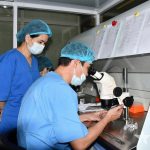
Doctors from the Department – Department of Pathology and Forensic Medicine, Military Hospital 103, Vietnam Military Medical University diagnose the biopsy test results. Photo: VIET TRUNG
Reporter: Vietnam Military Medical University is aimed to build according to the model of “Research-oriented university”. According to you, what criteria do the Academy’s staff and lecturers need to achieve?
Major General, Associate Professor, Dr. Nghiem Duc Thuan: Currently, the Academy’s faculty and management staff are basically sufficient in quantity and meet quality requirements. However, to meet the criteria, the Academy’s staff and lecturers need to continue to improve their political bravery and constantly practice manners and discipline; must be truly “both knowledgeable and professional”, “bright in medical ethics, deep in medical theory, and good in medical techniques”. Officers and lecturers of Vietnam Military Medical University need to actively cultivate foreign languages, have a firm grasp of information technology, and improve the ability to self-study and do scientific research with a high spirit of creativity. Each officer and lecturer must be truly active and implement the spirit of 7 dares: “Dare to think; dare to say; dare to do; dare to take responsibility; dare to innovate and be creative; Dare to face difficulties, challenges and dare to act for the common good”, improve professional qualifications, professionalism and discipline; effectively use modern means and apply high-tech techniques in diagnosis and treatment; Improve capacity, perform well assigned responsibilities and tasks and international integration ability.
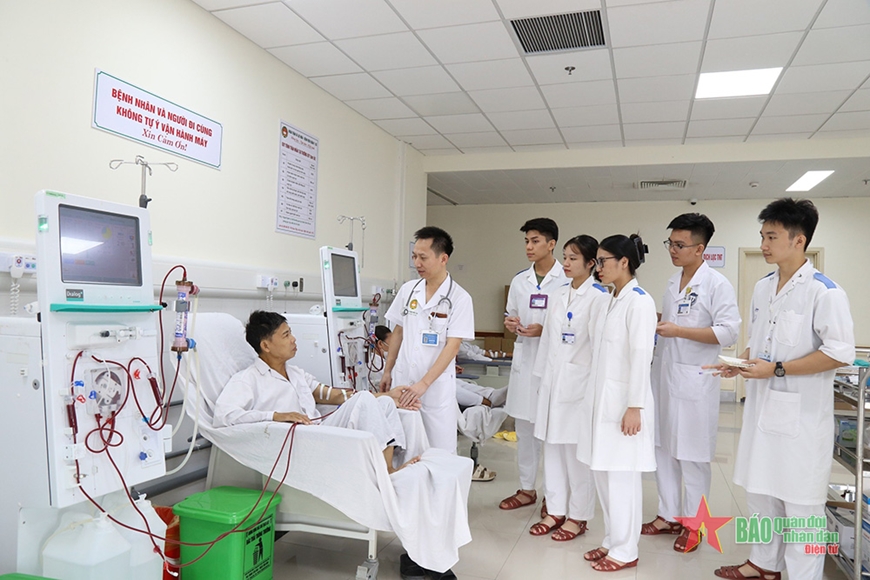
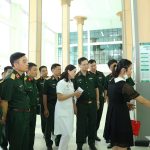
Visiting patients at the Kidney and Dialysis Department, Military Hospital 103, Vietnam Military Medical University. Photo: TUAN DUNG
Reporter: So, what solutions does the Academy have in building and developing its staff and lecturers in the coming time?
Major General, Associate Professor, Dr. Nghiem Duc Thuan: Vietnam Military Medical University determines that the first task is to improve the qualifications of its staff and lecturers. Through surveys and assessments of training needs and capacity; Identify key areas and industries that need training priority; create conditions for learners to make choices and be proactive in learning and research; Create favorable conditions for units to proactively exchange and cooperate in training, research and treatment. The Academy researches and promulgates a competency framework as a basis for developing training programs and materials for staff and lecturers. Along with that, the Academy focuses on innovating and perfecting mechanisms and policies for staff and lecturers; Have a recruitment policy to attract good scientists to serve long-term in the Academy and remuneration regime for visiting lecturers and educational administrators according to job position and professional title standards. Karma. Gradually increase investment and financial support to meet the actual requirements of training at doctoral and master’s levels.
Reporter: Sincerely thank you, comrade!
By: Pham Kien, Translated by Kieu Van