The place that trains versatile and excellent military physicians

As the leading institution for training, scientific research, examination, treatment, and healthcare for both soldiers and people, the Vietnam Military Medical University (VMMU) holds a prominent position within the Armed Forces and the nation. Throughout its construction and development, VMMU has consistently aligned closely with these missions, emphasizing the construction of a versatile “3-in-1” team of officers, and faculty.
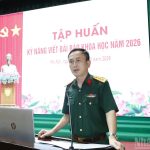
In the early days of the new year, VMMU organized two working trips to various localities to promote and guide military recruitment into the university for the year 2024. In January, the working delegation led by Lieutenant General, Associate Professor, and Doctor Nguyen Xuan Kien, the Director of VMMU, collaborated with the Ministry of National Defense, the Department of Education and Training of Nam Dinh Province to carry out promotional activities and career guidance for over 1,200 students at 11th and 12th grades from four high schools: Hoang Van Thu High School, Nguyen Duc Thuan High School, Nguyen Binh High School, and Luong The Vinh High School in Vu Ban district.
Subsequently, another working delegation led by Major General, Associate Professor, and Doctor Tran Ngoc Tuan, the Deputy Director of VMMU, went to Lao Cai province in collaboration with the Provincial Department of Defense, the Department of Education and Training to organize career guidance programs for students from several high schools in Lao Cai city. The promotional events and career guidance sessions took place in an open and lively atmosphere, attracting a large number of participating students. Many stories about the glorious traditions of VMMU were conveyed to the students.
Information about the study conditions, admission standards, questions about the registration process, the treatment provided during the study, and the conditions for placement after graduation were discussed enthusiastically by the university’s leadership and the students. During the event, many students expressed admiration for the illustrious traditions of the institution and demonstrated their determination to pass the entrance exam to join VMMU. Being present and witnessing these joyous moments, we sensed the presence of the values of spirit, the passion for the medical profession, and the dedication to life that the teachers and doctors of VMMU have spread to the young generation.
Discussing this issue, Lieutenant General, Associate Professor, and Doctor Nguyen Xuan Kien said that, given the unique nature of military medicine, the Party Committee and the Board of Directors of VMMU always prioritize and invest in education to build the institution into one of the top universities for training high-quality medical personnel for the military and the country. This includes research in military medicine, the transfer of medical techniques, being a high-quality treatment center, and developing international cooperation in medical education and research, contributing significantly to the nation’s construction and defense. Therefore, right from the recruitment stage, the university is highly concerned about and invests in promotion and career guidance with the hope of selecting talented individuals.
Furthermore, the university sets high standards and requirements for its staff, especially for military medical lecturers. Lecturers must be actual military medical officers excelling in all fields, possessing comprehensive and in-depth medical knowledge, effective teaching methods, strong scientific thinking, and a dedicated commitment to the profession. The selection process for lecturers is rigorous and stringent. To become a lecturer, candidates must pass various exams and assessments covering clinical skills, language proficiency, computer skills, and undergo a teaching trial before the Faculty Council; only then are they officially recognized as lecturers.

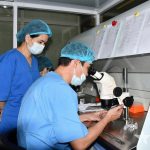
Colonel, Associate Professor, and Doctor Tran Ngoc Dung, Head of the Department of Pathological Anatomy and Forensic Medicine, along with diagnostic physicians, were interpreting biopsy test results. Photo: VIET TRUNG.
Implementing the “Hospital-School” model means that VMMU lecturers must also be practicing doctors. This requires lecturers to have broad medical knowledge, professional qualifications, excellent skills, a sense of medical ethics, and not allowing any mistakes in the treatment process, no matter how minor.
Having accompanied the university for many years, we have observed that through practical treatment, the lecturers and doctors at the institution have developed numerous new techniques, gained valuable experience in teaching, scientific research, and contributed to improving the quality of training and treatment. They have achieved breakthroughs in healthcare by successfully conducting the first kidney, liver, heart, combined pancreas-kidney, and lung transplants in the country, contributing to the remarkable development of the national healthcare system.
Until now, many people surely remember that on June 4, 1992, the first successful kidney transplant in Vietnam was performed under extremely challenging conditions at the Military Hospital 103 of VMMU. The patient was Major Vu Manh Doan, 40 years old, who received a kidney transplant from his 28-year-old younger brother. The success of this first transplant marked a new chapter in the country’s medical history, initiating a new field in Vietnam – organ transplantation. In 2004, the Military Hospital 103 successfully performed a liver transplant for Nguyen Thi Diep (10 years old) from Nam Dinh, who suffered from congenital biliary atresia. The donor was her biological father (31 years old), who donated a portion of his liver.
Building on these successes, in 2010, the Military Hospital 103 successfully performed the first heart transplant in Vietnam. In 2017, a significant milestone was reached as the first lung transplant on a human was conducted at the Military Hospital 103. The patient, Ly Chuong Binh, from Bat Dai Son commune, Quan Ba district, Ha Giang province, underwent the procedure. Following the lung transplant, leaders from the Ministry of National Defense and the Ministry of Health visited and highly praised the success of the transplant. Particularly, the Prime Minister sent a commendation letter, praising the officials, doctors, and healthcare staff of VMMU.
Colonel, Associate Professor, and Doctor Ta Ba Thang has served VMMU for 32 years of military service. He couldn’t help but be emotional when recalling the significant milestones that the institution has achieved since its establishment. Following President Ho Chi Minh’s Order No. 234/SL dated August 20, 1948, regarding the establishment of medical training institutions, the Vietnam Military Medical School (the predecessor of the current VMMU) was established on March 10, 1949. The inaugural training session for military medics took place in Tuan Lung village, Hoang Hoa commune, Tam Dương district, Vinh Phuc province.
In its early days, the institution had only 20 officers, staff, and 4 lecturers; the facilities included only an assembly hall, two houses serving as living quarters and classrooms, and a kitchen – all made from simple materials like bamboo, thatch, and leaves. The specialized bookshelf consisted solely of French-language books contributed by lecturers who brought them during the resistance war. Initially, the school’s teaching equipment included only two old microscopes and a set of bones transferred from Viet Tri Hospital, used as anatomy teaching aids.
Today, the Vietnam Military Medical University is one of the leading medical centers in the military and one of the major scientific centers in the entire country. The university prioritizes learning through research, using scientific research to address issues in teaching, treatment, and enhance the quality of education, aiming to transform the institution into a research-oriented university. To ensure the effectiveness of scientific research, VMMU has various mechanisms and policies to support scientific projects, providing opportunities for faculty to conduct basic-level research projects, laying the groundwork for proposing and implementing research projects at the ministry and national levels.
The university focuses on comprehensive investment in equipment, modern laboratories (comparable to regional and global standards), and research centers to facilitate faculty in implementing scientific ideas. From 1986 to the present, VMMU has completed nearly 3,300 scientific projects at various levels, including hundreds at the state and ministry levels, along with thousands of technical innovation initiatives. It has received 2 projects awarded the Ho Chi Minh Prize, 2 scientific projects awarded the VIFOTEC Technical Innovation Prize, and 3 scientific projects awarded prizes by the World Intellectual Property Organization (WIPO). In 2018, it was granted a U.S. patent for one scientific project.
With a focus on building a versatile team of faculty and officers under the “3 in 1” model, which excels in the roles of educators, scientists, and doctors, the university has achieved remarkable success in training, scientific research, and medical treatment. Currently, over 93% of the faculty and staff at the university hold postgraduate degrees, including 53 professors, 234 associate professors, hundreds of doctors, masters, specialists of level II and level I, 15 People’s Teacher awardees, 42 outstanding teachers, 19 People’s Physicians, 179 outstanding physicians, and numerous leading specialists and technical experts in the military medical field. This highly qualified workforce is crucial for the continued growth and development of VMMU in the coming years, meeting the demands of building the military, and caring for the health of both the military and the civilian population.
News and images: Hoang Viet, Translator: Le Vien Lan Huong