Under the roof of the Vietnam Military Medical School

Growing up from the ranks of the National Defense medics, then passing the entrance exam for the third class of the Vietnam Military Medical School (now the Vietnam Military Medical University), he participated in the construction, organization, and gradual perfection of the military medical system serving combat throughout the years of resistance against the French colonialists and the American empire. At the age of 96, whenever he recalls those early days, Major General, Professor, Doctor, Hero of the People’s Armed Forces Nguyễn Tụ, former Party Secretary, Deputy Director of Political Affairs of the Vietnam Military Medical University, feels deeply moved.
“In early 1950, I was serving as the Head of the Political Work Department, Party Secretary of the Military Medical Department (Viet Bac Interzone), when the Head of the Department, Doctor Phạm Gia Lăng, called me to announce the recruitment for the third class of military medics and encouraged me to apply. I took the exam at the scheduled time, tried my best, and was admitted.
At that time, the Vietnam Military Medical School was located in Vô Tranh village (Phú Lương, Thái Nguyên). Due to work handover, I was allowed to enroll about a month later than the announced gathering time. After submitting my documents and registering, I was led to a platoon of cadets commanded by Brother Uyên. Our home was a bamboo and thatch house, with a bamboo floor bed for over 20 people. Platoon leader Uyên informed us that these were the latecomers, mostly from distant Interzones 3 and 4, who had difficulty traveling and arrived late, so the school arranged for us to study specialized subjects in clinical symptoms and internal medicine.
Our teachers at the time included Mr. Nguyễn Thế Khánh, Mr. Vũ Kim Vinh, and later Mr. Đặng Văn Ngữ from Japan, who was assigned to research and produce Penicillin filtered water for treating the wounded. Additionally, there were several medical students like Brothers Huy Phan, Ngọc Phan, Hữu Mô, and those working in hospitals like Vũ Triệu An, Brother Thanh, Brother Ngọc Mô… who helped tutor us. We didn’t have much classroom time and mostly self-studied and practiced at the hospital. Our only reference materials were a set of French medical books, which the students took turns reading and copying for their personal use. The most profound impression on me was the teachers’ enthusiasm, approachability, and dedication to teaching and guiding us. On rainy days, the teachers’ houses were not far from the classroom, but they had to cross small streams and muddy, slippery paths which were difficult to navigate. Mr. Khánh and Mr. Ngữ would carry their sandals and walk barefoot through the mud, needing to wash at the stream before entering the classroom. To this day, I still remember Mr. Ngữ’s very vivid, practical lectures on parasites, especially malaria parasites. With Mr. Khánh, I felt both admiration and astonishment as he performed a gastric section on a patient we were observing. Although he specialized in internal medicine, his surgical skills were impeccable.
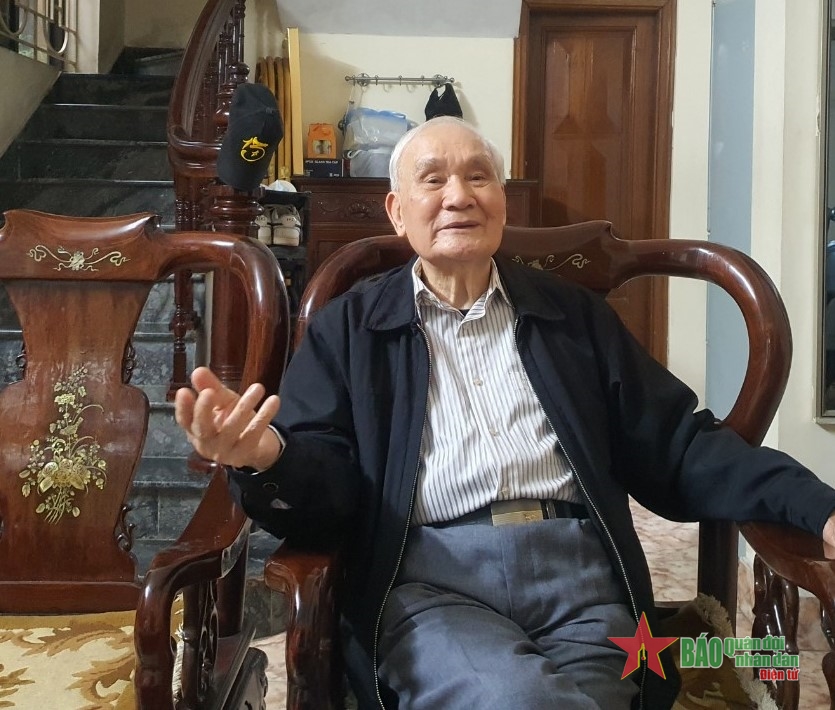 |
| Major General Nguyễn Tụ. Photo: BẢO MINH |
At the beginning of 1951, after the forces returned from serving in various campaigns, our class gathered and began the official curriculum. We were divided into three platoons, organized into a Party cell belonging to the school’s Party committee, with over 100 students in total. Our company commander, Đoàn Liên Thanh, had graduated as an army officer in China. Later, he also passed the medical school entrance exam, graduated as a doctor, and married Ms. Du, a medical officer from the second class.
At this time, the resistance against the French colonists moved into a counter-offensive and offensive phase. The country’s resources had to be concentrated on the frontline, so life and study at the school were extremely difficult and lacking. We had to fend for ourselves in repairing our living quarters, study materials, etc. The school could only provide lunch and dinner, mostly stir-fried peanuts and home-grown vegetable soup, with meat or fish occasionally. Personal utensils had to be self-provided, varying from porcelain to iron or plastic bowls, but bamboo chopsticks were somewhat standard. Despite these conditions, under the leadership of the Party cell, spiritual life, culture-arts, physical education, sports, and competition among the platoons remained vibrant and regular. We even organized a Student Union, led by Mr. Nguyễn Văn Hồ. In the afternoons, except for those on hospital duty, the rest took turns in productive labor, learning to sing, playing volleyball, and even practicing the “International Dance”…
Our third class’s curriculum was mainly based on the teachings of the French Indochina Medical School. Learning from the experiences of previous classes to timely provide medical officers for the fighting troops, as directed by the Medical Department and based on the battlefield’s practical requirements, medical personnel had to immediately perform procedures to save injured and sick soldiers. Therefore, the school prioritized teaching subjects relevant to emergency wartime surgery. We learned about symptoms in conjunction with physiology, internal medicine pathology, treatment methods, and prevention of common diseases, combined with hospital practice. Due to the severe lack of teaching equipment, we had to ask for unclaimed human skeletons for study purposes. For some cross-sectional images of body parts and important lectures, the school encouraged students with neat handwriting and drawing skills to be exempt from productive labor to write and draw on stones for lithographic printing to distribute to the cadet platoons… Despite the difficulties and shortages, the students’ eagerness to learn and the teachers’ and tutors’ enthusiasm of “all for the students” were unparalleled. I remember when practicing at the hospital, we encountered a tuberculosis patient with a rare cave souffle sound in the lungs. Due to the large number of students who had not heard it or heard it clearly, outside of class hours, even during night shifts, many tutors quietly encouraged and persistently asked the patient to allow students to listen again. Many borrowed or even hid bones from class to take home for further study. Teachers from Hanoi who joined the resistance brought their families and also had to learn to adapt to the difficult, lacking conditions. It was touching when we learned that Mr. Huấn had to eat watery porridge before teaching all day!
 |
| Classroom session of the Vietnam Military Medical School in 1949. Archive photo. |
The efforts of teachers and students at the Vietnam Military Medical School were recognized. In 1951, a conference organized by the Medical Department decided on many important contents in building the revolutionary military medical sector. After years of diligent research and study, Mr. Đỗ Xuân Hợp completed the compilation of “Anatomy of the Limbs and Practical Surgery”; Mr. Nguyễn Trinh Cơ finished “What You Need to Know About Surgery in War” for medical officers in the battlefields. These first specialized books demonstrated the superiority of Vietnam’s independent education. Mr. Hợp’s book was praised by Uncle Ho and awarded the Third-Class Resistance Medal by the State.
For me personally, after completing the course, I was assigned to the Medical Department of Division 316. At the end of 1952, during the Northwest Campaign, I accompanied the Division headquarters and a regiment to attack the Quang Huy-Phù Yên area, then quickly advanced towards Tạ Khoa (Sơn La), destroying and pushing back enemy posts along the corridor of Road 41 (now National Highway 6). We had about 20 wounded in this phase. After sorting and treating some of the wounded on-site, the rest were handed over to the Medical Department’s treatment team at the rear. I remember one day, Comrade Đặng Kim Giang, the Campaign Supply Manager, came to inspect our Division 316’s treatment team’s cooking for the wounded and saw the cook struggling to prepare scrambled eggs, so he rolled up his sleeves and showed him how to do it right away. Admirable!
Then one campaign followed another, and I gradually became proficient in my specialty. How could I forget the peak of the second phase of the Điện Biên Phủ Campaign in 1954, when my team had to receive up to a thousand wounded on March 30 and 31 alone. The medical soldiers “spun like tops,” but everyone tried their best to fight for the lives of their comrades. Besides, there are countless unforgettable experiences from 10 years of arduous and fierce fighting in the Central Highlands during the resistance against the Americans. As the Chief of Military Medicine on the Central Highlands Front, I, along with hundreds of white-coated soldiers, diligently fulfilled every duty so that we could return and continue to contribute, participating in the training of subsequent military medical students. Looking back on the journey I’ve traveled, I am always grateful for the days I spent studying at the Vietnam Military Medical School—the place that laid the first foundations, giving me the basic knowledge to confidently stride forward on the path I chose.
Narrator: Major General NGUYEN TU, Recorder: THANH TUAN, Translator: NGUYEN NGOC ANH