Upholding tradition while continuously innovating and enhancing the quality of education

With the rich tradition and expertise of white-coat soldiers, in recent years, the Party Committee and the Board of Directors of the Vietnam Military Medical University (VMMU) have led and directed the construction of the VMMU into the leading center for training, treatment, and research in military medicine in Vietnam, achieving an advanced level in the region and integrating more deeply with the international community. A reporter from the People’s Army Newspaper had a conversation with Lieutenant General, Associate Professor, People’s Doctor Nguyen Xuan Kien, Director of the VMMU, about this story.
Reporter: Established during the early years of our country’s resistance war against French colonialism, the officers and students of the Vietnam Military Medical School—the precursor unit of the VMMU today—had to both fight and engage in teaching, learning, and participating in the care of military health, treating wounded and sick soldiers. Therefore, over the periods, the name of the institution has also changed to suit the practical conditions. Specifically, what were those changes, sir?
Lt. Gen. Nguyen Xuan Kien: The VMMU, under the Ministry of National Defence, traces its origins back to the Vietnam Military Medical School, established by Directive No. 234/SL on August 20, 1948, by President Ho Chi Minh and Decree No. 187/NĐ on October 4, 1948, jointly issued by the Ministries of National Defenve, Health, and Education. In difficult and harsh conditions, the first military medical training course commenced on March 10, 1949, in Tuan Lung hamlet, Hoang Hoa commune, Tam Duong district, Vinh Phuc province. Within 8 years (1949-1957), the school successfully trained 6 courses, producing over 600 military medics, promptly meeting the demands for treating wounded and sick soldiers on the battlefields. From its inception as the Vietnam Military Medical School, it evolved into the Medical Officer School (1957-1962), then the Military Medical Research Institute (1962-1966), the Military Medical University (1966-1981), and finally the VMMU (since 1981). Today, the VMMU stands as one of the leading centers for training, scientific research, and treatment within the military and the country as a whole.

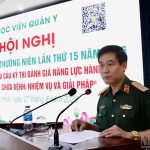
Lt. Gen. Nguyen Xuan Kien
Reporter: When researching the history of the VMMU, we are deeply impressed by the spirit of overcoming difficulties and selfless sacrifice for the mission of generations at VMMU. Who are the exemplary figures that can be mentioned, sir?
Lt. Gen. Nguyen Xuan Kien: On its inception, the infrastructure of the academy was extremely basic and modest. The entire facility had only four teachers, comprising a single hall, two makeshift buildings serving as both living quarters and classrooms, and one kitchen, all constructed from bamboo, thatch, and leaves. The specialized bookshelf consisted solely of French-language books contributed by teachers who brought them along during the resistance war. The initial teaching aids included only two old microscopes and a set of human bones used for anatomy lessons… Despite all challenges, the faculty and students of the University excellently fulfilled their duties and were honored three times with the title of Hero of the People’s Armed Forces. Later generations like us always take pride in mentioning the names of Professor Dinh Van Thang, Professor Nguyen Trinh Co, Major General, Professor, Hero of the People’s Armed Forces Do Xuan Hop, Major General, Professor, Hero of the People’s Armed Forces Nguyen Thuc Mau, Major General, Professor, Doctor of Science, Hero of the People’s Armed Forces Le The Trung, Major General, Professor, Doctor of Science, Hero of the People’s Armed Forces Nguyen Tu, Lieutenant General Nguyen Trong Hop, Lieutenant General, Professor, Doctor of Science, People’s Teacher Pham Gia Khanh… With talent and dedication to scientific advancement, these teachers have brought fame to the VMMU, the military medical sector, and the country’s medical profession as a whole.
Reporter: Currently, the VMMU is recognized as one of the leading centers for training, scientific research, and medical treatment in the country and the military. Could you please provide some highlights of the academy’s achievements and accomplishments in recent years?
Lt. Gen. Nguyen Xuan Kien: Currently, the VMMU has 44 affiliated units, including two practicing hospitals (Military Hospital 103 and the Le Huu Trac National Burn Hospital) and the Military Clinical Embryo Institute. The University boasts over 93% of its staff and faculty holding postgraduate qualifications, including 53 professors and 234 associate professors. There are also hundreds of doctors with specialist qualifications, including second-level and first-level Specialists, as well as 15 People’s Teachers and 42 Meritorious Teachers. Additionally, there are 19 People’s Doctors and 179 Meritorious Doctors, along with 10 leading technical specialists in their respective fields.
Regarding the research and technical application achievements of the VMMU, I would like to summarize some key figures. Since its establishment, the University has trained over 100,000 medical personnel for both the military and the nation. This includes more than 1,200 doctoral degrees, over 10,000 master’s degrees, and specialists in various medical fields. Additionally, nearly 30,000 doctors, pharmacists, bachelor’s degree nurses, technical bachelor’s degree holders, reserve officers, and over 60,000 healthcare workers have been trained. The University has completed nearly 1,000 scientific projects, including over 220 state-level projects and more than 700 projects at the ministry, department, and university levels. Moreover, there have been over 200 technical innovations and improvements. In terms of medical treatment, the University has applied and developed new and modern techniques, contributing to the improvement of diagnostic and treatment quality. Special attention has been given to investing in and developing specialized fields in military medicine, such as emergency treatment, initial management, and sequelae of various types of injuries, burns, internal medicine, and surgical pathology during wartime; endoscopy in diagnosis and treatment, vascular intervention techniques, organ transplantation, aesthetic surgery, and regenerative medicine have been maintained and improved. Furthermore, support for reproductive health and tissue transplantation has been provided.
Reporter: Those are truly impressive numbers. To achieve such success, the VMMU must have had fundamental strategies and solutions during the implementation process, wouldn’t it, sir?
Lt. Gen. Nguyen Xuan Kien: Proud of the 75-year tradition of fighting, building, and maturing, in recent years, the leadership and command at all levels of the VMMU have always inherited the achievements and experiences in history, while actively, proactively, creatively, and resolutely implementing effective strategies and solutions as follows:
Firstly, thoroughly implementing the resolutions of the Party, Central Military Commission, directives of the Ministry of National Defence, General Staff, and the tasks of the military, correctly applying creativity in training, military medical research, treatment of wounded soldiers, and patients. Building a competent and reputable team of officers and staff, especially leaders and leading specialists with good qualities, high professional qualifications, and commanding and managerial abilities.
Secondly, firmly adhering to the motto “The training quality of the University is the combat readiness capability of the unit,” strictly implementing military and defense work orders on training and scientific research, regularly consolidating unity, consensus, democracy, and discipline throughout the University, creating the best environment for all officers and staff to promote their professional abilities, focusing on improving the quality of military medical training and research to enhance the quality of healthcare for the entire military, meeting the requirements of building a regular, elite, and modern army.
Thirdly, developing and implementing high-quality training programs for all levels based on competencies and outcomes standards, aiming to become a multidisciplinary health sciences university, leading in military medical research and training in Vietnam, on par with advanced universities in the region.
Fourthly, with the goal of building a comprehensive model of a university-hospital, the practical hospitals of the Univeristy regularly promote ethics, effectively apply advanced techniques and technologies, develop specialized technical expertise to become leading treatment centers nationwide and in the region. At the same time, they serve well for training, medical research, and military medicine.
Fifthly, regularly building a comprehensive and strong University as a “model, exemplary” institution, taking political construction as the foundation, striving to fulfill all tasks assigned by the Party, State, and the military. Expanding and strengthening cooperation with universities, scientific institutions, hospitals domestically and internationally in the fields of training, scientific research, and treatment; enhancing the close relationship with local authorities and people where the University is located, creating the best conditions for the development of technical expertise and building VMMU into a leading university in the healthcare sector.
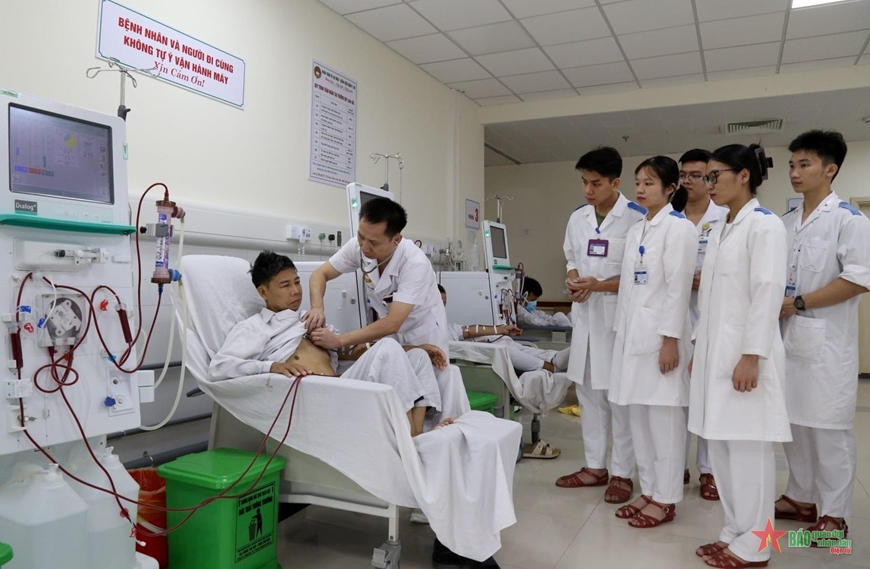
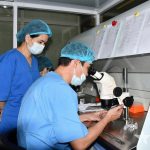
Cadets are guided and trained in clinical treatment at the Department of Nephrology and Hemodialysis, Military Hospital 103. Photo: TUAN DUNG
Reporter: It is known that VMMU is striving to become a multidisciplinary health science university, aiming to become a leading research and training institution in military medicine in Vietnam, on par with advanced universities in the region. So, how is the direction and roadmap to implement this determination being carried out, sir?
Lt. Gen. Nguyen Xuan Kien: Upholding tradition, innovating and enhancing the quality of education and training, the Party Committee and the Board of Directors of the Vietnam Military Medical University have led and directed the effective implementation of building, adjusting, and innovating training programs at each level and discipline; developing and issuing standards appropriate to each target. Proactively developing plans, proposals to open new majors, training programs at all levels and disciplines. Strengthening coordination with training institutions, hospitals, and healthcare facilities at home and abroad to organize specialized training courses oriented towards continuous, in-depth training, and address practical needs.
Gradually innovating teaching and learning processes, assessment methods, and result evaluation. The project “Innovation of training processes, programs for officers at all levels in the military to meet the requirements of new situations” continues to be implemented concurrently with completing the project to open doctoral training programs; implementing doctoral training programs in military medicine. Reviewing, issuing module textbooks, and other textbooks to serve the innovation of military medical training programs with the principle of prioritizing trainees, students, and the quality of medical care. Actively incorporating feedback from units, localities, healthcare facilities, where the “products” of the VMMU are used to adjust the content, substance of teaching programs to closely match the requirements and demands of practical situations.
Enhancing cooperation both domestically and internationally, accelerating the development and application of advanced scientific-technological advancements, especially in the field of military medicine. Strengthening the development of cutting-edge techniques in diagnosis and treatment. Implementing the establishment of strong research laboratories, groups, integrating clinical research with fundamental research. As a result, the quality and value of scientific works have made breakthroughs with a significantly higher number of international publications compared to previous years.
In the coming time, the Party Committee and the Board of Directors of the VMMU will focus on leading and directing the construction of a clean and strong Party organization, exemplary units, and building a comprehensive and exemplary unit as a solid foundation to achieve the goals of developing the University into a leading center in the country and the region for training, scientific research, and treatment; providing high-quality healthcare personnel for the military and the nation, making significant contributions to the cause of protecting, caring for, and improving the health of the military and the people, deserving of the trust of the Party, the State, and the military, as well as the love and trust of the military and the people.
Reporter: Thank you very much!
Written by BICH TRANG, Translated by VU DAT